The 2017 Ecstatic Truth Symposium took place on May 27 and explored the field of animated documentary. Presentations by scholars and practitioners from around the world covered topics including memory, trauma, visual and verbal language, industry structure and new technologies.
The day kicked off with a keynote by Bella Honess Roe, who expanded on the idea of 'absence and excess' that she put forward in her monograph Animated Documentary. Using the examples of two short films - Abuelas and Irinka and Sandrinka - Honess Roe demonstrated that animation can be used both as metaphorical wish fulfilment and as an exploration of memory, both memories of events directly experienced and memories passed down through families and cultures. Honess Roe spoke about how animation studies academics strive to pin down animation in theoretical terms, but find that definitive conclusions are elusive. She suggested that this is due to the vastness of animation as a discipline: “Very few animated documentaries look alike”. Perhaps this resistance to reductive conclusions is one of animation's strengths.
In her presentation “Traversing the terrain of space, time and form”, Rose Bond gave an insight into her research and production process when making large scale architectural animations. Her work interprets the histories of buildings into narratives and symbolic motifs that are then projected back onto the windows of the building itself. Her storyboarding process was particularly interesting to see, as she boarded the different narratives that played out across the different windows - a more lateral process than traditional storyboarding. She referred to this "multiscreen" boarding as "a different kind of editing, composing". The process of storyboarding was the moment of 'parataxis', the juxtaposing of individual visual and narrative elements together to create new meaning for those elements. Bond explained that in her work it is important that the audience do not see all the material when they watch - they are required to chose which images to focus on throughout, so the experience is different with each viewing.
Next up I presented a paper about animated documentary and virtual reality, proposing that the absence and excess (Honess Roe, 2013) of animated documentary is complemented by the dual qualities of immersion and alienation present in VR. I supported my argument with the analysis of two recent animated VR documentaries - Nonny de la Peña's Out of Exile and Michelle and Uri Kranot's Nothing Happens.
Vincenzo Maselli's presentation on “Deeper strata of meanings in stop-motion animation: the meta-diegetic performance of matter” explored ideas of performance and materiality of stop-motion, referencing the work of Marks, Sobchack and Barker in an analysis of the relationship between the human body and the texture of filmed material.
Sally Pearce's paper entitled “Can I draw my own memory?” focused on her work tracking memory, and the problems presented by this. She showed a piece of work in which an animated horse wanders through bleak live action landscapes that represent her fractured memories from a time of serious illness. This record of illness is, she explains, "straight from the horse’s mouth". She discussed her process of trying to capture and visualise memory, and the frustrations that come with this: “I try to use my pencil as a scalpel to extract a memory whole, but the memory will not be drawn out like a lump of tissue, instead it changes as soon as the pencil touches it. As my memory changes under the pencil, I am changed, I redraw myself.” Pearce particularly noted that her drawings can feel trapped in the language we commonly use about memory and illness and bound up in accepted metaphor, frustrated that "my drawing mind remains locked into the forms of the spoken and written word".
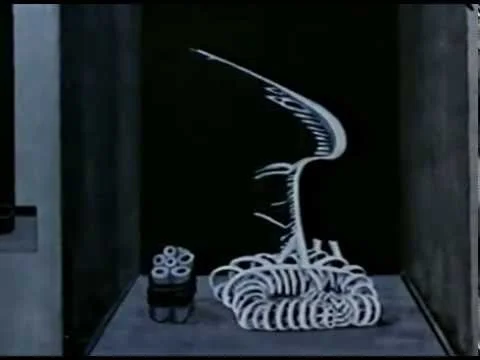
Barnaby Dicker's paper "A Quivering Terminus: Walerian Borowczyk’s Games of Angels, animated documentary and the social fantastic" analyses how Borowczyk uses 'fantastic topography' to play with tropes of both documentary and fiction, in order to a explore disturbing historical subject. Dicker's analysis of Borowczyk’s disturbing and powerful short looked at how both imagery and structure worked to create meaning for the audience. He commented on the clues the filmmaker's uses to guide the audience, such as the inclusion of a title card providing assurance that characters and events portrayed in the film are not intended to resemble characters living and dead. Dicker noted that the film is highly abstract and would not in any way invite an assumption that it was portraying real characters - so in fact the title card may be working inversely, to suggest to an audience that what they are watching does, in fact, reflect reality.
The afternoon sessions included a talk from Chinese artist Lei Lei who offered a lively tour of the process behind his compelling and visually stunning artwork. LeiLei uses found materials and processes of enhancing and degrading images to interrogate history, memory and culture.
Guli Silberstein's presentation of his work "The Schizophrenic State Project", gave an insight into the personal context which led him to appropriate and adapt media footage of violence to specifically explore conflict in Israel, Palestine and the region. The presentation offered an intimate view of an artist striving to find a voice to communicate his complex relationship with a disturbing subject matter which is both deeply personal and boldly political. In processing and re-presenting footage of war and protest Silberstein recontextualises it, challenging a viewer to watch and consider it in a new way.
Becky James' paper "Expanding the Index in Animated Documentary” considered the subgenre of animation about mental states through a close reading of Betina Kuntzsch’s Spirit Away. James also offered insights into the culture around animated documentary production in comparison to the fine art industry where she previously worked, suggesting that there is an absence of critique and serious professional support for emerging filmmakers through canonical institutions in the field of experimental animation.
Susan Young's presentation “Bearing Witness: Autoethnographic Animation and the Metabolism of Trauma” showcased her PhD research on psychological trauma, in which she reflects on her own experience. Young showed her visceral short film The Betrayal and discussed her process, sharing the ways in which she managed the risks associated with conducting any research on trauma.
The 2016 Ecstatic Truth symposium concluded with a sense of agreement that the arguments around the legitimacy of animation as a documentary form which have dominated much of animated documentary scholarship are not useful, and that we can progress better if we start from a working assumption that animated documentary can exist as a valid form. The 2017 event followed on from this, taking a broad perspective on animated documentary that allowed for an open, discursive atmosphere in which diverse ideas could be raised, considered and challenged. There were no definitive answers but, as Honess Roe suggested at the beginning of the day, maybe animation's ability to elude the finality of concrete definition is at the heart of its charm.