• Work
  • About

MACKINNONWORKS

  • Work
  • About

Animated Documentaries at London International Animation Festival

The London International Animation Festival (LIAF) has included a dedicated screening of animated documentaries in its programme for the last nine years. In a recent interview Festival Director Nag Vladermersky told me that when the documentary-focused screening was first devised it showcased both new and old work, but over the years the quantity of animated documentary submissions the festival has received has increased and the screening now includes only new work. Vladermersky observes that film and animation schools are producing a growing number of student films in the animated documentary form, which in combination with the growth in funded animated documentaries supported by organisations such as Wellcome Trust, has led to this sharp increase in submissions. The LIAF animated documentary screening provides a good opportunity for the festival to reach new audiences; Vladermersky notes that the screening is marketed to documentary enthusiasts as well as to the animation community.

In recent years the LIAF animated documentary screening has seen steadily increasing audiences, and feedback from the events are excellent, with audience members 'quite effusive' in their written feedback. Vladermersky believes that the quality of filmmaker discussion after the screening is particularly high in the case of animated documentary, making the overall festival experience richer for audiences. Vladermersky is often asked by live action documentary filmmakers for recommendations of animators that they could work with, as they increasingly recognise animation as a good way to create interest in work which would otherwise feel like a talking heads piece. He personally considers animated documentary to be “a great opportunity for filmmakers to really push, to show the internal as well as external world and really add a visual layer to what could otherwise be a visually boring documentary”. Despite this, Vladermersky notes that too many of the submissions that LIAF receive are 'talky' or 'illustrative', and do not experiment with the potential of the form. 

The 2016 programme of animated documentary presented a broad range of styles and approaches. Several films used animation in an illustrative manner to visualise stories told in voice over. The most striking of these was perhaps Sophie's Story (Christos Hatjoullis, UK), a compelling testimony from a woman about her experience of overcoming addiction in order to be allowed to care for her baby. Tough (Jennifer Zheng, UK) used the format of questions and answers between the filmmaker and her Chinese mother to explore her parents' experiences of the Cultural Revolution as well as her own identity as a second generation British Chinese woman.

Jonas Odell's I Was a Winner uses characters based on gaming avatars to explore gaming addiction. In this film former addicts are depicted as their in-game characters, inhabiting their game world, telling their stories 'to camera' talking-heads-style. The characters seem relaxed in the game world but they are alone. Are they revisiting a world that used to be populated and vibrant, now finding it empty? Or are we seeing a part of the interviewee that has been trapped in this world, left behind by the player who finally quit? The film's strange atmosphere encourages this question as well as delivering touching stories that hold the attention. 

Samantha Moore's Loop, made as part of Animate Project's Silent Signal slate, does a good job of interrogating not only its scientific subject matter but also the nature of both scientific and creative investigation and representation. As we hear the voices of scientists struggling to describe how they visualise the biological subject they are seeking to understand, Moore's visuals attempt to keep up, showing us illustrations of their imaginative descriptions. The film was made using Moore's distinctive process of participant feedback, in which she creates multiple iterations of her illustrations until the subjects are satisfied that they are effective visualisations of their ideas or experiences.

Twiddly Things, by Adara Todd, offers a striking vision of what it's like to live inside a mind suffering from Alzheimers. Beginning in a fantastical landscape, the film gradually draws threads to the real world where we find the its subject. The interview that leads the film is simple but very touching. It really draws the audience into the experience of losing control of the perception of external reality, of inhabiting a consciousness drifting between external and internal worlds.

Broken – The Women’s Prison at Hoheneck (Volker Schlecht and Alexander Lahl, Germany) was one of the most traditional animated documentaries in the programme. It tells the harrowing story of women imprisoned by the GDR for their political beliefs. Strong visuals support verbal accounts, shedding light on this ugly moment from history. Other programme highlights included: Private Parts (Anna Ginsburg, UK), an entertaining tour of contemporary attitudes to female sexuality and genitalia; Micki (Izabela Plucinska and Alexander Lahl, Germany), a visually innovative account of a young woman's death while trying to cross the Berlin wall and Little Elephant (Kate Jessop, UK), a thoughtful document of an Indian woman's difficulty reconciling her sexuality with her family's beliefs. 

As a LIAF jury member, I shared the difficult talk of choosing a winning film in the documentary category. After extensive debate, the awarded film was selected as Empty Space, by Estonian filmmaker Ülo Pikkov. The majority of this stop-motion film depicts a young girl playing in a carefully constructed set. She explores her space and entertains herself, alone but at ease. As the film progresses a sense of danger is introduced, as forces from outside seem to threaten the stability of her little world. The set of the film is in fact original doll furniture built in the 1940s by Leonhard Lina, a former officer of the Estonian Defence Force who was forced into hiding to avoid capture and imprisonment. Trapped in a small hiding place for years, Line built a detailed miniature replica of the home he had left behind. After a decade in hiding, Lina rejoined the world and his family and gave the miniature furniture to his daughter as a gift. In the years that has passed however, she had grown too old to play with dolls. Pikkov draws on interviews with Lina's daughter to create this film, and she also appears occasionally and mysteriously in the film, a real-life woman overlooking the set. While some context as to the story is offered by text cards at the end of the film, the indexical material included is obscure. The origin of the furniture and the character of the doll are not presented explicitly and the presence of the relatively giant, live-action woman occasionally overseeing the scene is not explained in the main text of the film. Instead, Pikkov paints an impressionistic picture of the story's emotional thread, creating a film that contains a profound sense of isolation, longing, nostalgia and loss. This bold and creative approach to exploring a true story pays off in a memorable, touching film that is steeped in atmosphere.
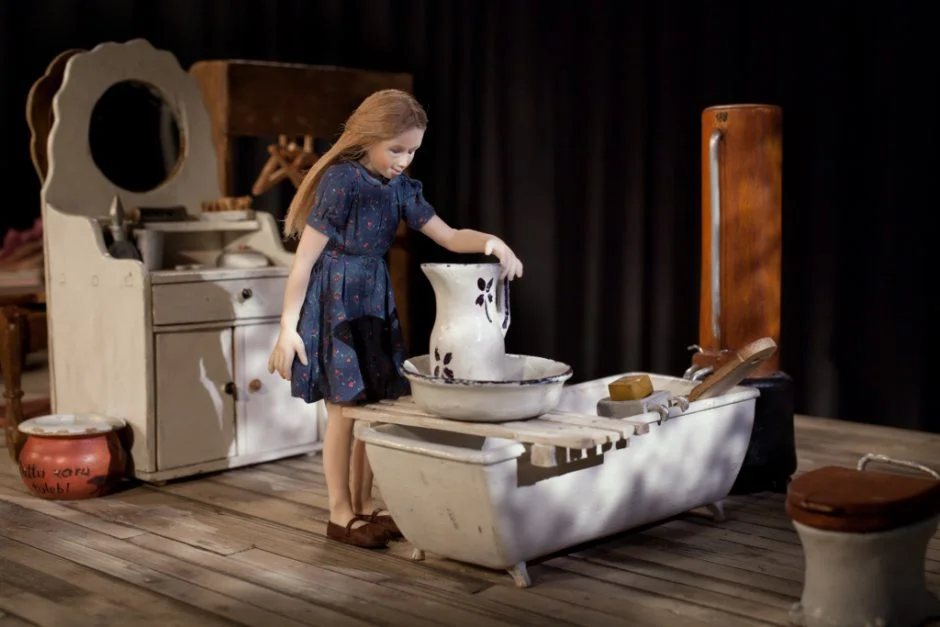
Still from Empty Space
Still from Empty Space

tags: Festivals, animation, animated documentary, LIAF, London International Animation Festival, Nag Vladermersky, Christos Hatjoullis, sophie's story, jennifer zheng, jonas odell i was a winner, samantha moore loop, adara todd twiddly things, Broken – The Women’s Prison at Hoheneck, Volker Schlecht, Alexander Lahl, Little Elephant Kate Jessop, Ülo Pikkov, empty space
categories: Reviews
Tuesday 01.03.17
Posted by Carla MacKinnon
 

Review of Animated Documentary

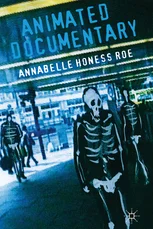
I have reviewed Annabelle Honess Roe's book Animated Documentary for the current issue of Animation an interdisciplinary journal 11(3).  

The book is essential reading for anyone with an interest in animated documentary, offering an excellent overview of the both the history of the form and scholarship in the area, as well as suggesting a new way to categorise animated documentary, by the way in which animation is used in the documentary film. Honess Roe argues that animation can be used either as: mimetic substitution, standing in for missing footage in an imitative fashion; non-mimetic substitution, standing in for missing footage but creating new meaning through the substituted image; or evocation, in which animation expresses something which cannot be captured on film such as a feeling or psychological state. It's a fresh and useful way to look at animated documentary and these and other ideas in the book will have value for both scholars and practitioners who want to explore the form of the animated doc.   

animateddocumentary
tags: Annabelle Honess Roe, Animation an interdisciplinary journal, animated documentary
categories: Reviews
Monday 10.31.16
Posted by Carla MacKinnon
 

States of Mind: Perspective Tour

In September I was invited to lead a ‘Perspective Tour’ around the Wellcome Collection’s States of Mind: Tracing the Edges of Consciousness exhibition, which includes an animated documentary installation artwork which I created as part of the Sleep Paralysis Project. I'll try to distill some of my thoughts on the show into this post.

One of the most compelling threads in the exhibition is the disruption of conscious experience – what happens when there is a glitch in the smooth flow of everyday experience which makes us doubt our own perception. When we are reminded that perhaps we can’t trust ourselves. A related theme in the show explores what happens when we perceive our consciousness to be separated from our body, and how this plays to our deepest fears and desires.

The themes of development and memory occur throughout the show. Several pieces look at how our early development shapes our consciousness, which is wrapped up with our sense of identity. As the mother of a two-month old baby, I often wonder what kind of consciousness he experiences. In the last few weeks he seems to have discovered that he is a body, separate from the rest of the world, and able to influence it. How the body of him relates to what is outside it may still be mysterious to him. I wonder if he thinks I am an extension of his body, as I am always with him and responding to his needs as soon as they arise. Maybe he thinks he controls me like he controls his hands and feet. Last week, I left him with his dad for a couple of hours as I had an appointment to make. He cried hysterically while his frantic dad tried to soothe him and I hurried home. It was his first real experience of separation from me and perhaps his first clue that we are not one and the same entity.

Our consciousness and perception is bound up with our identity and we intuitively link this to our autobiographical memories – the fragments that we piece together into the story we tell ourselves, about ourselves.

In the participatory work Timeline, Louise K Wilson asks visitors to write down their earliest specific memory, and the approximate age they were when the memory was formed, and add it to a growing collection on the wall, organised in age groups. As these memories gather together we have the chance to glimpse fragments of individual lives, but also see how these collected individual moments play together. The aggregation of the memories makes it possible to spot patterns and themes. Are there particular types of experiences that recur, that seem to make an impression and stick with us?

Of course these memories are now memories many times remembered, woven into the fabric of the identity of the adult rememberer. One of my earliest memories is of the red and white stripes of my pushchair, set at an angle against the black and white stripes of a zebra crossing. Which all made sense, until a couple of weeks ago when my mother told me that my pushchair was orange.

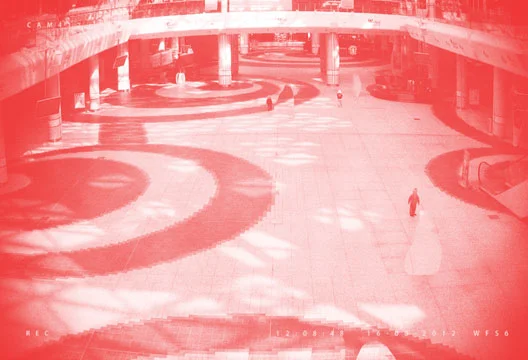
The unreliability of memory is explored by AR Hopwood through a series of works in his False Memory Archive. The work in this exhibition, Crudely Erased Adults, is a large photographic print depicting a security camera image of a shopping centre. In the image, all the adults have been obliterated roughly in photoshop, leaving the untouched images of scattered children.

Crudely Erased Adults

Crudely Erased Adults

This work references a study by psychologist Elizabeth Loftus in which she showed that it is possible to create false memories in test subjects. In essence she implanted a false memory in subjects of being lost in a shopping mall as a child, managing to get this memory to ‘stick’ in a quarter of subjects. Loftus and other psychologists have shown that our memories are massively malleable. We don’t take in nearly as much information as we think we do on a moment by moment basis, and the holes in our perception are filled by other things when they become memories. This 'filler' is usually based on what we know about the world and what we expect, but our imagination can be easily swayed by suggestion. And once a false memory is repeated many times as part of our autobiographical memory, it is hard to shift. I wonder if any of the memories in Timeline really happened as they are remembered.

The use of a security camera image in Crudely Erased Adults is interesting. My own memories are mostly visual and first person but some are a tableau seen from the outside – I don’t know why certain memories have taken on this form. The style of the image in Crudely Erased Adults seems to suggest objectivity and truth, but the crudeness of the photoshop work makes it clear that the image lies to us. The choice of a surveillance style image also suggests voyeurism – someone outside with access to our own intimate memories – able not only to view them but also to alter them.

Have you ever found a memory leaving you confused, unsure as to if it is a memory of a dream or a real event? Ideas of the unreliability of perception and memory are explores in the sleep section of the exhibition.

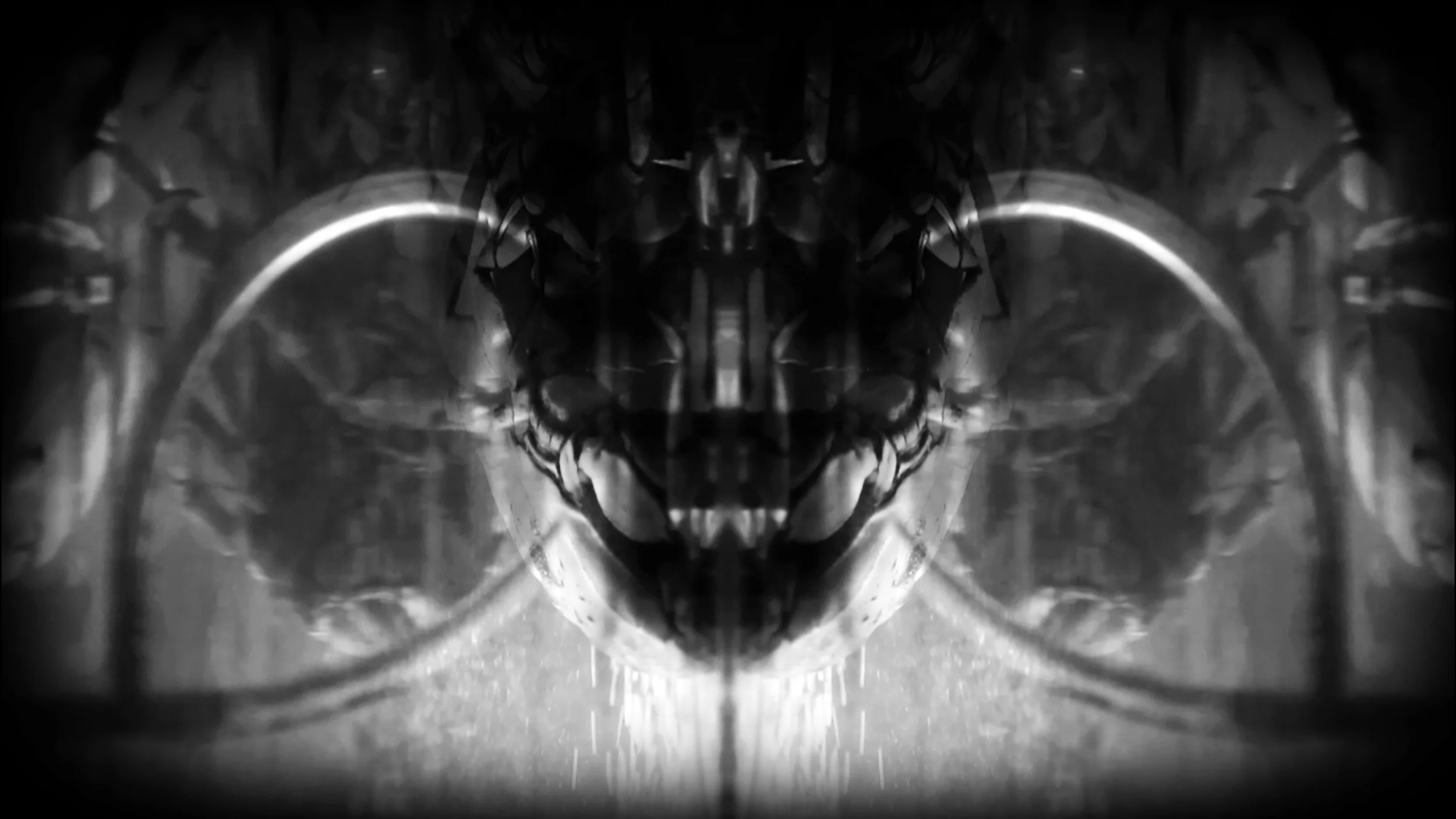
My own installation, Squeezed by Shadows, looks at the experience of sleep paralysis. Have you ever woken up in the night, maybe just on the edge of sleep, and discovered that you can’t move? If so you’re among around 30% of the population who have experienced sleep paralysis. Sometimes this is simply a feeling of the body being paralysed but sometimes the experience includes visual, auditory, tactile or olfactory hallucinations, a feeling of crushing pressure on the chest and a sense of terror. Often people say that during an episode of sleep paralysis they were certain that someone or something was in the room with them, that this visitor was evil, that it had its own consciousness and that it had malevolent intent. The sensation of being locked in a sleep paralysis experience can feel very unnatural. It can feel as if you are witnessing a part of yourself – the workings of your unconscious mind - which should be kept hidden from you.

Squeezed by Shadows

Squeezed by Shadows

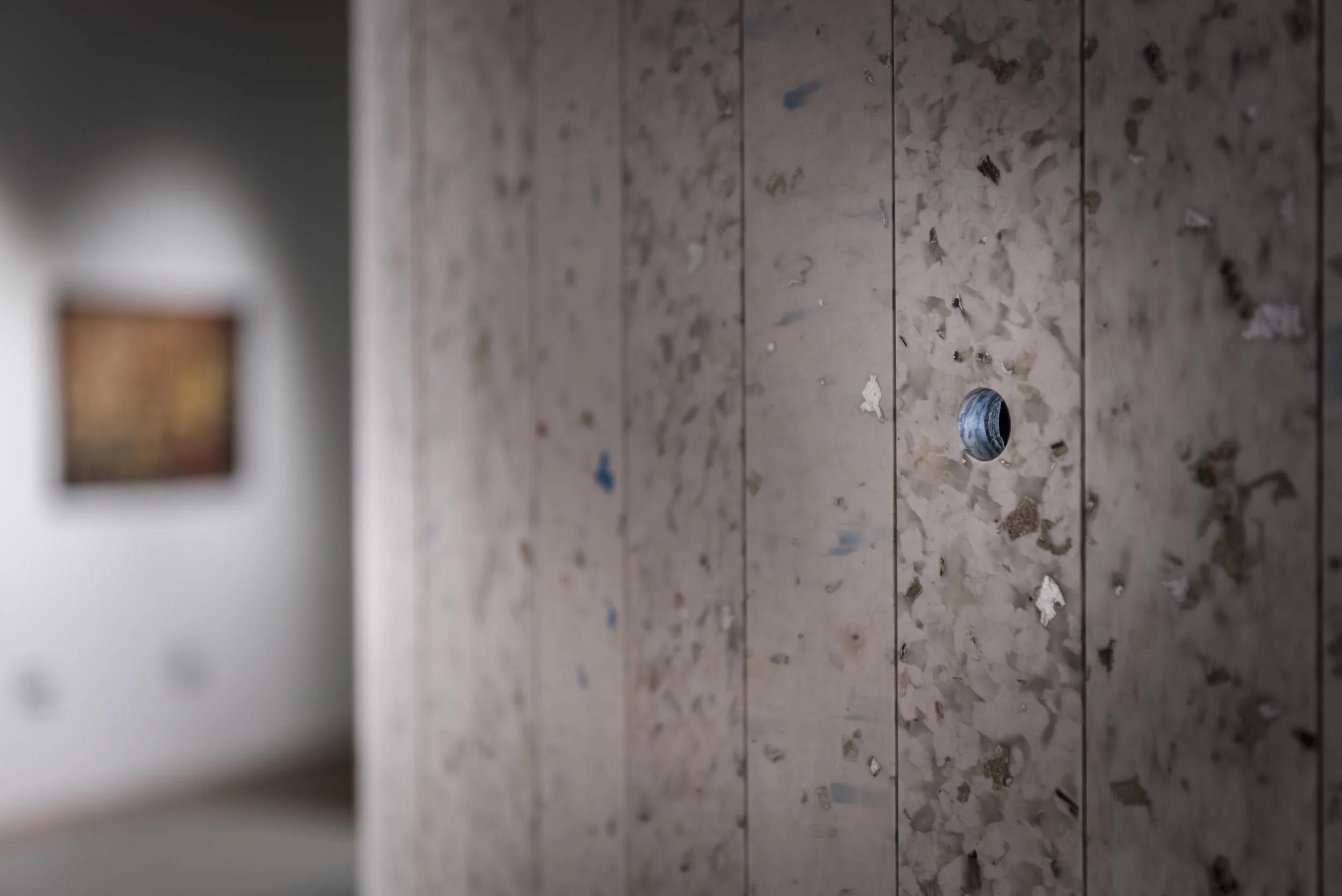
Squeezed by Shadows peephole

Squeezed by Shadows peephole

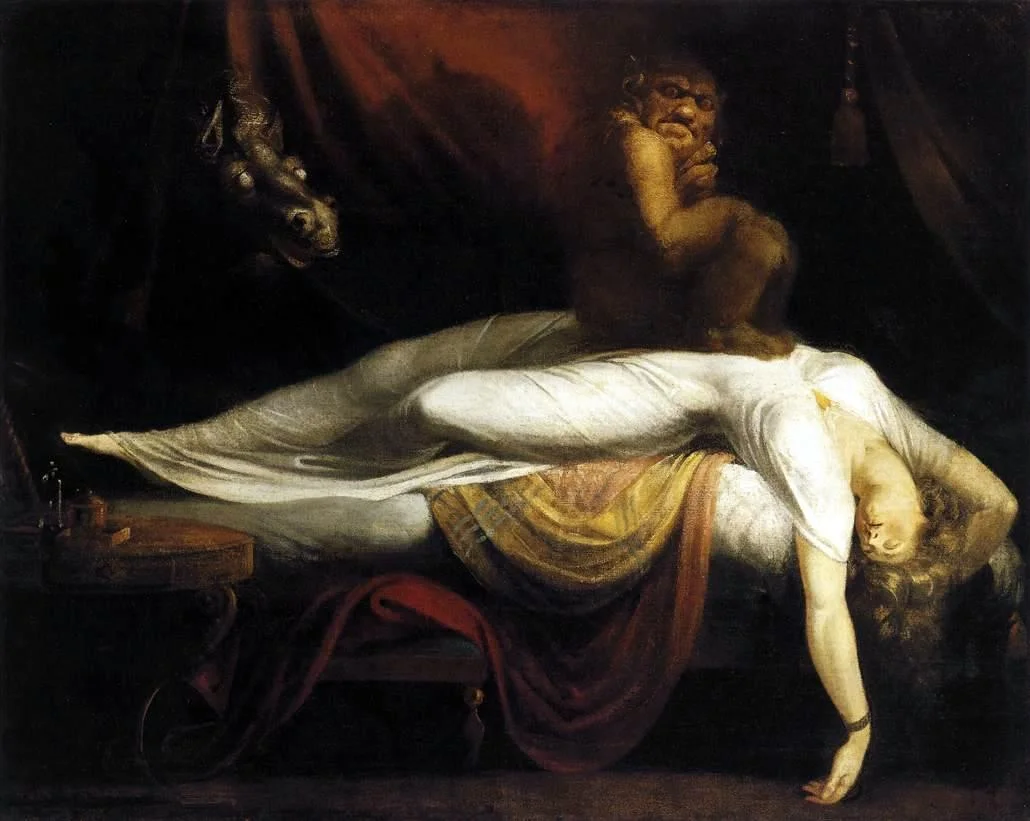
The Nightmare by Fusilli is the image most often used to illustrate sleep paralysis. With it’s demonic visitor crouching on the chest of a prone sleeper and an eerie visitor in the form of a white horse poking its head through the curtains of the room, the image captures many key elements of the sleep paralysis experience. The image is also steeped in surreal sexuality, which is a commonly reported aspect of sleep paralysis. It has been suggested that sleep paralysis is at the root of the mythological Incubus and Succubus – supernatural, demonic creatures that seduce sleepers at night. Other mythological characters from around the world have been linked to sleep paralysis including the Old Hag of Newfoundland and Japan’s Kanashibari. Some researchers believe that many reports of ghostly, alien, demonic or angelic visitations can also be explained through sleep paralysis.

The Nightmare

The Nightmare

The science behind sleep paralysis can be a revelation to those who experience it. When we are in dream sleep, our bodies are paralysed to prevent us acting out the actions in our dreams. When we wake up this paralysis lifts. When something disrupts the smooth process of going into or coming out of dream sleep, sleep paralysis can occur. We essentially jump a sleep stage and become conscious while our bodies are still asleep, paralysed - so we find we can’t move. Some scientists believe that the pressure on the chest is caused by the conscious sleeper trying to take control of their breathing, which is still automatically regulated as it is during sleep. The amygdala, the part of our brain responsible for fear and threat, is highly active during sleep paralysis, which may account for the sense of presence. Because you are still halfway in a dream state, dream thinking and imagery pervade the experience, which can account for the frightening hallucinations.

Several years ago I made a short animated documentary film about sleep paralysis, called Devil In the Room. As part of my research I interviewed dozens of sleep paralysis sufferers about their experiences. Some of these interviews have been edited together into the audio for Squeezed by Shadows. The audio is played through directional microphones, so visitors are able to step into a private pool of sound. They can then put their eye to a peephole in a curved wall and see abstract moving images inspired by reports of sleep paralysis experiences. In this way the visitor is invited to take private peek into someone’s internal life.

Also in the sleep section of the exhibition is News Story, an exhibit outlining the grisly details of the first ever criminal case in which the accused was acquitted on a defence of sleepwalking. The defendant, who murdered his father, claims to have been asleep for the whole incident, of which he has no memory. This story, of killing a loved one while asleep and unaware, taps into our most primal fears. There are two possible stories here. The man could be lying, in which case the story becomes a kind of noir crime thriller. Or he is telling the truth, in which case it is more of a Greek tragedy. In Euripide’s Herecles, the Gods curse Herecles with madness for long enough for him to kill his family in a deluded frenzy, before they bestow the greater curse of sanity, so he can wake up and see what he has done.

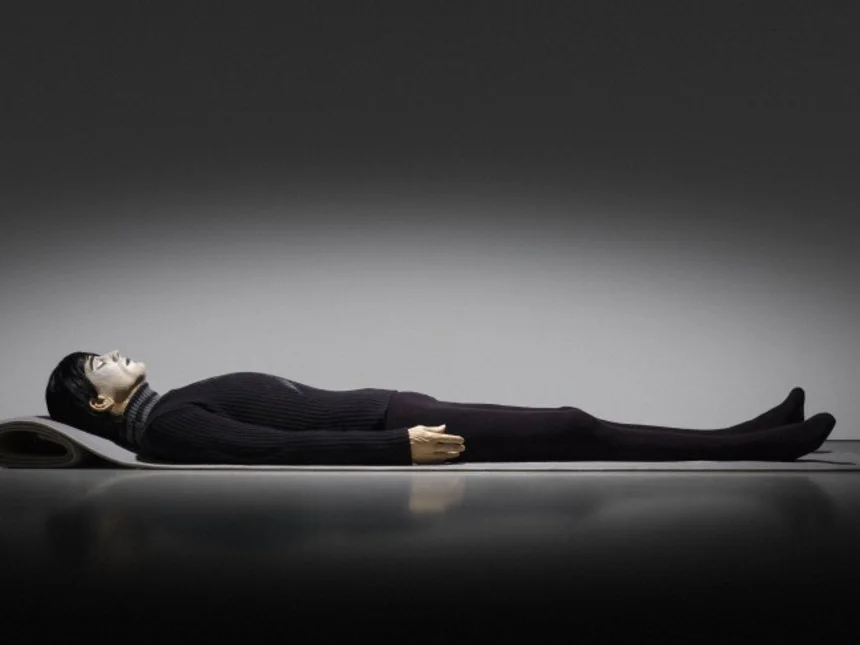
Also presented in the sleep section of the gallery is a clip from the 1920 film The Cabinet of Dr Caligari, in which a sinister puppetmaster uses a somnambulist to murder people, raising and controlling him like a zombie. Caligari’s iconic somnambulist is recreated in a carved sculpture by Goshka Macuga. The Somnambulist lies awkwardly on the floor, forcing visitors to move around him. Near to him, in a separate exhibit, is a monitor displaying footage from a real-life sleep study, in which a surveillance camera captures a patient in the throes of night terrors. The grainy black and white footage shows a human in a raw state of fear, psychologically naked and vulnerable. This is made stranger by the knowledge that the person will have no memory of the event being filmed – it is a characteristic of night terrors that the sleeper does not recall them in the morning.

The positioning of the somnambulist sculpture in the space, especially in proximity to the sleep-study video, once again evokes a kind of sinister voyeurism. This time we, the gallery visitor, becomes the intruder, the dark presence observing what we should not have access to – the privacy of another’s sleep.

The Somnambulist

The Somnambulist


tags: States of Mind: Tracing the Edges of Consciousness, Wellcome Collection, Wellcome, Sleep Paralysis Project, psychology, Louise K Wilson, False Memory Archive, AR Hopwood, Crudely Erased Adults, Elizabeth Loftus, Squeezed by Shadows, sleep paralysis, Goshka Macuga
categories: Reviews
Tuesday 10.11.16
Posted by Carla MacKinnon